
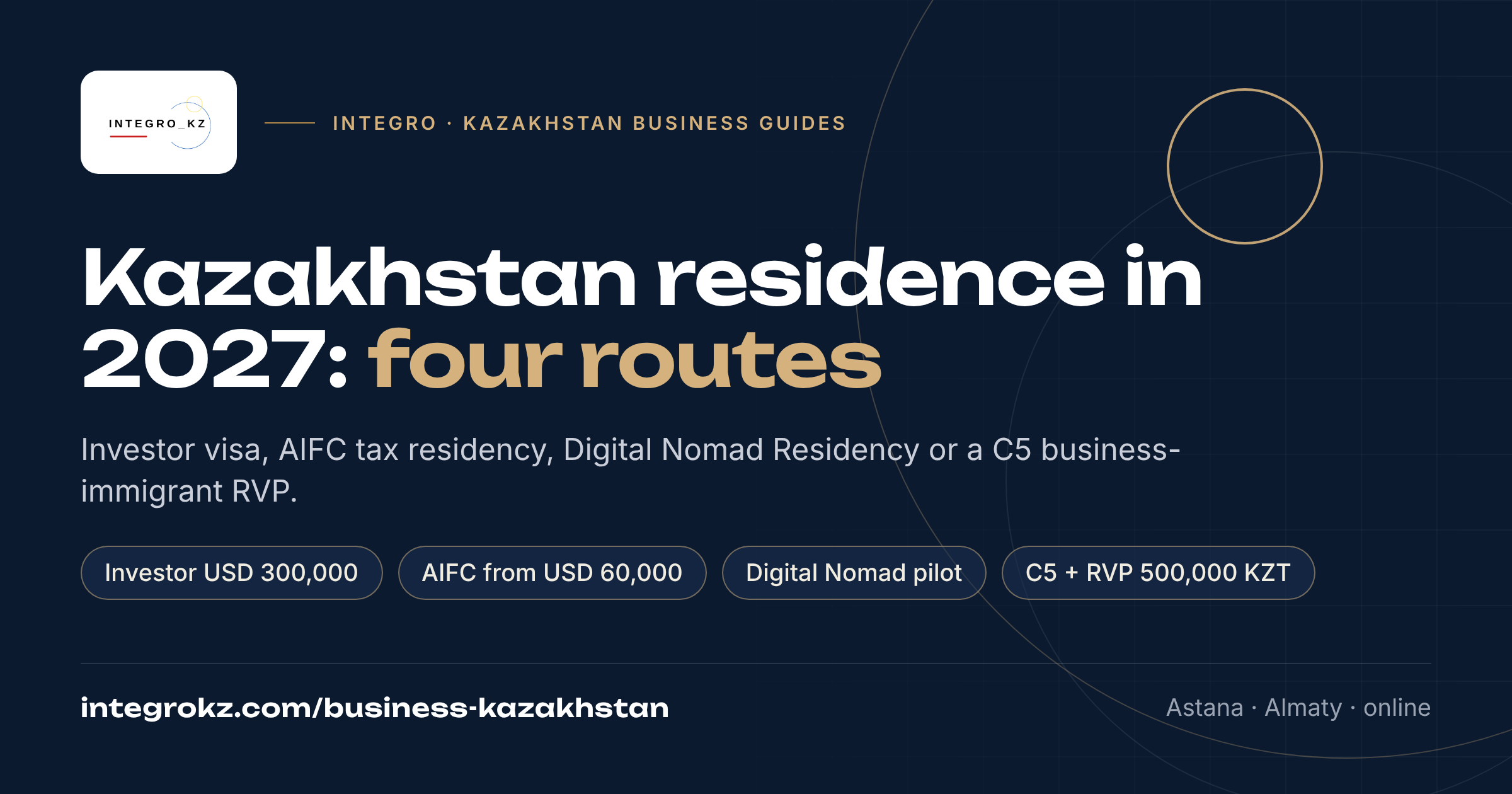
If you want to live in Kazakhstan for years rather than weeks, there are four realistic routes in 2027: the investor visa (from about USD 300,000 invested), the AIFC Investment Tax Residency Programme (from USD 60,000 in AIX-listed securities, with a 5-year visa and tax residency after 90 days), Digital Nomad Residency for IT specialists from visa-free countries (no investment at all, a permit for up to 10 years, pilot running to 31 December 2026), and the business-immigrant route: a C5 visa plus temporary residence permit built on your own Kazakh LLP. A fifth, the Altyn golden visa, was announced by Presidential Decree No. 1242 of 25 April 2026 but has no published thresholds or adopted law as of 4 November 2026.
All four share one new advantage. Since Resolution No. 890 introduced QazETA, every visa-free visitor must pre-register before each trip; holders of a Kazakhstan visa or residence permit are exempt. Pick a residence route and the QazETA question disappears. Below: money, time, rights and paperwork for each, and where we help.
Short answer:
- Investor visa (Integro's C9 service; category A5 in the visa rules): invest the equivalent of USD 300,000 and the support letter can run up to 10 years. Best for capital going into an operating business.
- AIFC Investment Tax Residency: USD 60,000 in AIX securities or AIFC company capital (USD 150,000 in digital assets), processing fee USD 7,750 (USD 11,375 with spouse), 5-year A5 visa for the family, tax residency after 90 days instead of 183.
- Digital Nomad Residency: IT professionals from visa-free countries, no income or investment test, permit up to 10 years, about 3 months; pilot in Astana and Almaty until 31 December 2026.
- Business-immigrant RVP: register an LLP (from 500,000 KZT, 3-5 days), get a C5 visa and RVP (500,000 KZT); you may run your company without a work permit.
- Every route exempts you from QazETA because you hold a visa or residence permit.
- Altyn visa: promised tax exemptions and a Resident ID; nothing adopted yet.
The four routes side by side
| Route | Money in | Status you get | Work and business | Typical timeline |
|---|---|---|---|---|
| Investor visa (C9 / A5) | USD 300,000 invested in the Kazakh economy (or investment contract, Foreign Investors' Council membership) | Multiple-entry visa; support letter up to 10 years (5 or 3 on other grounds); family included | Head the investing entity | 8-16 weeks including the investment project |
| AIFC Investment Tax Residency | USD 60,000 in AIX securities or AIFC share capital; USD 150,000 in digital assets; fees USD 7,750 or 11,375 | 5-year A5 investor visa for applicant, spouse and children; tax residency after 90 days | Run or own AIFC entities; passive investor otherwise | AIFC company 3-6 weeks; certificate and visa on top |
| Route | Money in | Status you get | Work and business | Typical timeline |
|---|---|---|---|---|
| Digital Nomad Residency | None; proof of IT profession | Residence permit up to 10 years (within passport validity) | Employment, sole proprietorship or company allowed | About 3 months |
| C5 + business-immigrant RVP | LLP charter capital (no fixed minimum for most activities) plus service fees | C5 visa up to 2 years, renewable, with RVP | Run your own company, no work permit | LLP 3-5 days; visa and RVP several weeks to a few months |
Route 1: the investor visa for USD 300,000 and up
This is the route for someone buying into or building a real business: a plant, a logistics hub, a stake in a Kazakh LLP in a priority sector. The visa is issued on a support letter from the investment authority. Under the Ministry of Foreign Affairs order of 25 April 2025 (No. 11-1-4/247) the letter can be issued for up to 10 years to an individual who has invested the equivalent of USD 300,000 in the Kazakh economy in the previous 12 months; for up to 5 years to a member of the Foreign Investors' Council or the holder of an investment contract; and for up to 3 years on the recommendation of a state body or quasi-state entity. The authority reviews the file within 3 working days.
One naming point: our site and most clients call this the C9 investor visa; the visa tables published by Kazakh Invest and the AIFC code it as A5. Same document. What does not count: real estate on its own, bank deposits, loans or crypto held personally. The investment has to be in the economy, documented and traceable. Our detailed guide to the investor visa and AIFC residency walks through qualifying investments and the 8-16 week timeline; the company side usually starts with registering an LLP and a corporate bank account.
Route 2: AIFC Investment Tax Residency for portfolio investors
The Astana International Financial Centre runs the lowest-threshold investment route. A foreign national aged 18 or over who has not been a Kazakh tax resident or citizen in the previous 20 years invests at least USD 60,000 in securities listed on the Astana International Exchange or in the share capital of AIFC-registered companies (USD 150,000 if the investment is in digital assets on AFSA-licensed platforms), pays a processing fee of USD 7,750 (USD 11,375 with a spouse) and receives an investment residence certificate. With it come a 5-year A5 investor visa for the applicant, spouse and children under 18, and the right to become a Kazakh tax resident after 90 calendar days of presence in a 12-month period instead of the usual 183. Children under 16 need no separate temporary residence permit. The investment must be held for the certificate's validity, and the funds must reach the AIX account through an AIX CSD participant.
Two caveats. The programme charges an annual tax residency fee of 7,000 MCI (about 30.3 million KZT at the 2026 MCI of 4,325 KZT), so it suits people who want Kazakh tax residency as such, not just a place to live. And the Altyn visa framework promises to cut the AIFC minimum stay from 90 to 30 days; that is a proposal, not law. If you also want an operating company inside the Centre, our AIFC registration service (980,000 KZT, 3-6 weeks) and the comparison of AIFC versus a Kazakhstan LLP cover the choice.
Deciding between USD 60,000 in AIX securities and USD 300,000 in an operating business, or wondering whether your IT background qualifies for Digital Nomad Residency? Send us your passport country, budget and plans. We will map the routes you qualify for, with costs and dates. Message a manager on WhatsApp or Telegram, +7 707 681 65 06.
Route 3: Digital Nomad Residency for IT professionals
Digital Nomad Residency is the odd one out: no money in, but a narrow door. Astana Hub runs it with the Ministry of Digital Development and the Ministry of Internal Affairs as a pilot from 26 May to 31 December 2026 in Astana and Almaty. It is open to citizens of visa-free countries whose profession is on the official list of digital, innovation and aerospace specialities (developers, AI and security engineers, cloud administrators and similar). No income threshold, no bank statement, no language exam, no IT degree required; a convincing CV and portfolio carry the application. The result is a residence permit for up to 10 years within passport validity, with the right to take employment, register as a sole proprietor or found a company.
The process runs through astanahub.com and then eGov: application, an AI test, a video interview, a ministry petition decision (15-20 days), a residence permit application through eGov (up to 45 days) and card issuance at a public service centre (7-17 days). Plan on about 3 months and on having an IIN and electronic signature ready; our IIN and EDS services cover that. Citizens of visa-required countries use the Digital Nomad Visa instead: a one-year, extendable e-visa with no right to employment in a Kazakh company. See our Digital Nomad Residency guide, the visa versus residency comparison and the note on nomad taxes and costs. Whether the pilot continues after 31 December 2026 had not been announced as of 4 November; if you qualify, start with our Digital Nomad questionnaire now.
Route 4: the business-immigrant RVP built on your own LLP
For a founder who wants to run a company in Kazakhstan without a USD 300,000 cheque or an IT profession, the business-immigrant route is the workhorse. You register an LLP (a foreign individual can hold 100%), the company invites you, you receive a C5 business-immigrant visa for up to 2 years and a temporary residence permit tied to the business. As a business immigrant you may head your own company without a work permit. The RVP is renewed while the company operates, and years of lawful residence on it count toward a later permanent residence application.
The costs are predictable: LLP registration from 500,000 KZT in 3-5 business days, the business-immigrant RVP 500,000 KZT, a legal address at 70,000 KZT a month if you have no office yet, and accounting from 145,000 KZT a month once the company is live. One 2026 rule to keep in mind: since 1 November a company with tax debt of 45 MCI or more (194,625 KZT) unpaid for over 4 months cannot change its director or address, so keep the LLP's taxes current if your RVP depends on it. Our C3 vs C5 guide and RVP service page set out the documents.
What the Altyn visa and the new PR list would change (not law yet)
Two pending reforms could reshuffle this comparison in 2027. Presidential Decree No. 1242 of 25 April 2026 told the Government to create an Altyn Visa for investors and in-demand specialists by end-2026: exemption from personal income tax, property and land tax and from universal income declaration for the holder and family, about one-month processing for IT specialists, a digital Resident ID, recognition of foreign diplomas and the 30-day AIFC tax-residency rule. The Prime Minister still described it as proposed at the KGIR forum in Shymkent on 22 October 2026; a tax amendment package carrying the exemptions was discussed in the Kurultai on 28 October and is expected by year-end. No thresholds, amounts or durations have been published.
Separately, a draft Ministry of Labour order would expand the list of in-demand professions for permanent residence from 51 to 174 (medicine, engineering, IT, energy, transport, agriculture, education), allow a permit for up to 10 years without proof of solvency on a sectoral ministry's petition, and void it if the holder leaves the profession for 183 days in 12 months. Consultation closed on 6 October 2026; adoption was not confirmed as of 4 November. Our advice: do not wait for either. Start the route you qualify for today; if Altyn arrives with better terms, a holder of a valid visa or RVP will be in a stronger position to switch than a visitor on QazETA.
How to choose, and how Integro runs each file
The decision usually comes down to three facts about you.
- Capital you are willing to park: USD 300,000 in a business points to the investor visa; USD 60,000 in listed securities plus a wish for Kazakh tax residency points to the AIFC programme; neither is needed for Digital Nomad Residency or the C5 route.
- What you will do here: run an operating company (C5 + RVP, or investor visa), hold a portfolio (AIFC), or work remotely in IT (Digital Nomad).
- Passport and timing: Digital Nomad Residency needs a visa-free passport and an application before the pilot ends on 31 December 2026; the other three are open to any nationality year-round.
Our process is the same for all four. A consultation (from 35,000 KZT) to confirm eligibility and check your record for fines, tax debts or overstays that would block any application, including the QazETA for the trip you make to collect the card. A fixed-price contract. Then we prepare the company or AIFC entity, the investment documentation, the invitation or petition, and accompany you at the migration service in Astana or Almaty. Most steps run remotely; biometrics and card collection need you in person. Prices are on our price list, and the migration lawyer overview explains how the visa and permit work fits together.
Planning to move to Kazakhstan in 2027 and want the route that gets you out of the QazETA queue fastest? Write to Integro on WhatsApp or Telegram (+7 707 681 65 06), 09:00-21:00 daily. We will compare the investor, AIFC, Digital Nomad and C5 routes for your case under a fixed-price contract.
Frequently asked questions
Which Kazakhstan residence route is cheapest in cash terms?
Digital Nomad Residency has no investment or income requirement, only proof of an IT profession and a visa-free passport, so the cost is state fees and legal support. Next is the C5 business-immigrant route: LLP registration from 500,000 KZT and the RVP at 500,000 KZT, plus running costs of the company. The AIFC programme needs USD 60,000 invested plus USD 7,750 in fees and an annual tax residency fee; the investor visa needs USD 300,000.
Do these routes exempt me from QazETA?
Yes. Holders of a valid Kazakhstan visa and holders of a temporary or permanent residence permit are among the 29 exempt categories under Resolution No. 890 of 10 October 2026. An investor visa, the AIFC 5-year A5 visa, a Digital Nomad residence permit and a C5 visa with RVP all qualify. You will still need QazETA for trips before the document is issued, applied for at least 72 hours ahead.
Can I get Kazakh tax residency without staying 183 days?
Only through the AIFC Investment Tax Residency Programme as of November 2026: participants become tax residents after at least 90 calendar days of presence in a consecutive 12-month period, and pay an annual fee of 7,000 MCI. The Altyn visa framework proposes cutting this to 30 days, but no law has been adopted. On the other routes the general 183-day rule applies.
Is Digital Nomad Residency still open, and who qualifies?
The pilot runs from 26 May to 31 December 2026 in Astana and Almaty, operated by Astana Hub with the Ministry of Digital Development and the Ministry of Internal Affairs. It is open to citizens of visa-free countries with a profession on the official digital, innovation and aerospace list. There is no income test. The permit is valid for up to 10 years. Whether the pilot continues into 2027 had not been announced as of 4 November 2026.
Should I wait for the Altyn golden visa?
We advise against waiting. Presidential Decree No. 1242 of 25 April 2026 set a framework and promised tax exemptions and a Resident ID, but as of 4 November 2026 no thresholds, durations or implementing law exist, and the tax amendments were still being discussed in the Kurultai. Start the route you qualify for now; a holder of a valid visa or RVP will find it easier to switch if Altyn arrives with better terms.
How long does each route take with Integro?
LLP registration takes 3-5 business days and an AIFC company 3-6 weeks. A C5 visa and business-immigrant RVP add several weeks to a few months, depending on the consulate and migration service. Digital Nomad Residency runs about 3 months from application to card. The investor visa, including structuring and documenting the investment, typically takes 8-16 weeks. We give a written timeline before signing a fixed-price contract.
Can my family come with me on these routes?
Yes, with differences. The investor visa and the AIFC programme cover the spouse and children under 18 directly; under the AIFC programme children under 16 need no separate temporary residence permit. On the C5 and Digital Nomad routes the spouse and children usually obtain their own temporary residence permits under family reunification, which Integro files alongside the main application. Since 18 August 2026 spouses of citizens married over a year also get easier permanent residence terms.